Frost Heaves in Maine Driveways: Why They Happen and How a Proper Base Prevents Them
Cracks, bumps, and sunken spots after winter usually start below the asphalt. Here's what causes them, and what a long-lasting Maine driveway needs underneath.
Every spring, our phone starts ringing. Homeowners in Gray, Windham, and Yarmouth call about new cracks, bumps, and sunken spots in their driveways.
Most of them assume the asphalt failed. More often, the culprit is frost heaves.
The asphalt is just showing what went wrong underneath. In Maine, how long a driveway lasts depends mostly on what you can't see: the base and the drainage.
What Causes Frost Heaves?
It starts with water. When water soaks into the soil under your driveway and freezes, it expands.
Maine winters make this worse. Frost can reach several feet into the ground, and the soil goes through many freeze-thaw cycles between November and April.
Each cycle pushes the ground up, then lets it settle back down. It rarely settles evenly.
Asphalt can flex a little, but not that much. As the ground shifts, the pavement cracks, lifts, and sinks in uneven sections. Those are frost heaves, and they're one of the most common reasons driveways in our area fail early.
Water Is the Real Enemy
Frost heaves need water to form. Soil that stays dry, or drains quickly, has far less to freeze.
That's why the two most important parts of a driveway installation have nothing to do with the asphalt itself:
- A well-draining gravel base that lets water move down and away instead of sitting under the pavement
- Proper grading and slope so rain and snowmelt run off the surface instead of pooling
Skip either one, and even the best asphalt will struggle.
What Goes Into Proper Driveway Base Preparation
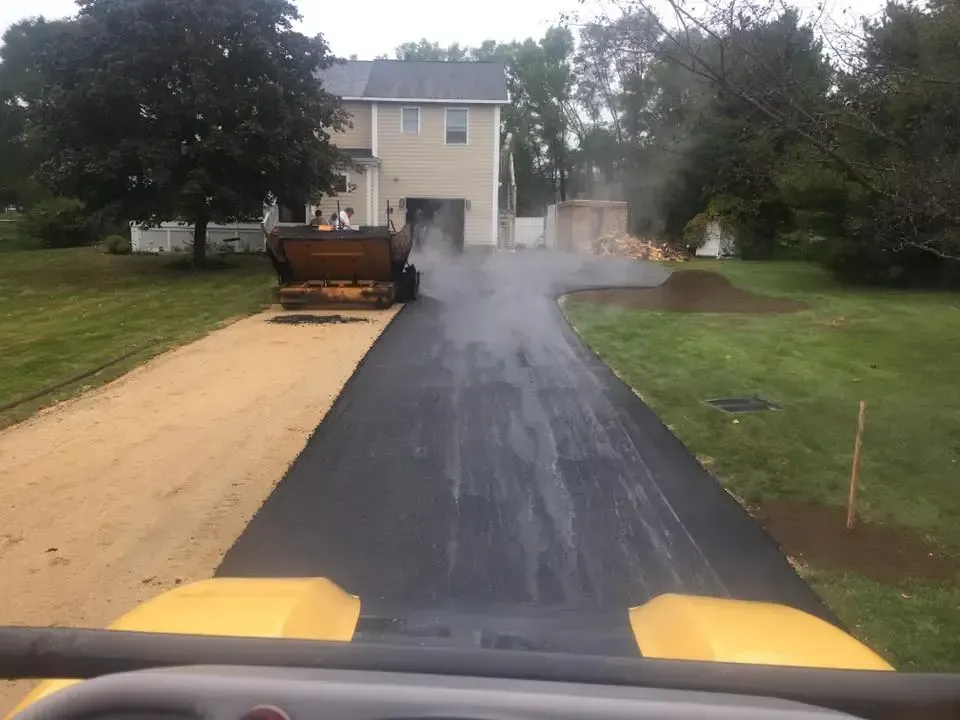
When FA Wing Paving handles a driveway installation, most of the important work happens before the paver ever shows up. Here's what that looks like:
- Excavation: We remove topsoil, organic material, and soft soil that holds moisture and can't support weight.
- Gravel base: We bring in and spread gravel. It drains water and gives the asphalt solid support.
- Grading for drainage: We shape the slope so water flows away from your house, your garage, and the center of the driveway.
- Compaction: We roll and compact the base so it won't settle under your vehicles later.
- Paving and edges: Only then do we lay and compact the asphalt. We finish the edges so they won't crumble.
Yes, this takes more time and material. But it's the difference between a driveway that holds up for years and one that's cracking after three winters.
Warning Signs Your Driveway Base Has a Problem
Some surface cracking is normal as asphalt ages. These signs are different. They usually point to trouble underneath:
- Alligator cracking: a web of connected cracks that looks like reptile skin, often caused by a weak or wet base
- Sinking or dips where water pools after it rains
- Humps and ridges that appear every winter and flatten out by summer
- Potholes that keep coming back after patching
- Crumbling edges where the base was too thin or didn't extend to the sides
Seeing any of these? Sealing or patching will only buy you time. The long-term fix is correcting the base.
Driveway Repair vs. Replacement: Can Frost Heaves Be Fixed?
Often, yes. It depends on how much of the driveway is affected.
If the damage is in one area, like a low spot by the garage or a wet section near a downspout, we can usually dig out that section. Then we rebuild it with a proper base and drainage, and repave.
If the problem runs the whole length of the driveway, a full replacement is usually the better investment.
How to Help Prevent Driveway Cracks and Heaving
A few simple habits go a long way:
- Point downspouts and sump pump discharges away from the driveway
- Clear snowbanks from the edges so meltwater has somewhere to go
- Fill small cracks before winter so water can't get in
- Keep heavy equipment off the edges
Frequently Asked Questions
Why did my neighbor's driveway hold up when mine didn't? It almost always comes down to what's underneath: base depth, gravel quality, compaction, and drainage.
Will sealcoating fix frost heaves? No. Sealcoating protects the surface of the asphalt. It can't fix a base that's holding water or shifting. Frost heaves have to be fixed at the base.
Does ledge or clay soil make a difference? Yes. Clay holds water, and ledge can trap it. Both are common in southern Maine, and both need extra attention to drainage and base prep.
When should I fix frost heave damage? Plan it for paving season. Spring and early fall are ideal. Our post on the best time to pave your driveway in Maine explains why timing matters.
Build It Right the First Time
FA Wing Paving is a family-owned paving contractor based in Gray, Maine. For more than 30 years, we've been building driveways made to handle Maine winters.
Is your driveway heaving, cracking, or holding water? Contact us for a free estimate or call 207-657-4259.
We serve Gray, Windham, Yarmouth, Auburn, and the surrounding communities.